Get free quotes from septic inspection near you
Takes about a minute. Free, no obligation; providers reply to you directly.
My neighbor found out the hard way. He hired a guy he found on Craigslist to inspect his septic system before listing his house. The inspector poked around the tank, declared everything “fine,” and charged him $75. Two weeks later, the buyers’ lender required a certified inspection — and that one found a failed drainfield that cost $18,000 to replace. The $75 “inspection” had looked at exactly the wrong thing.
That story gets told at every real estate closing office in rural America. And yet plenty of homeowners still aren’t sure what the credential actually buys them.
The Short Version:For a pre-sale inspection or anything involving a complex system (ATT, sand filter, mound), hire a certified inspector — full stop. For a routine tank checkup on a simple gravity system you’ve owned for years, an experienced non-certified pumper can be sufficient. The credential matters most when the stakes are highest.
Key Takeaways
- Certified inspectors examine the entire system — tank, drainfield, distribution box, pipes — while non-certified inspectors typically check the tank only for leaks and drainage.
- Several states mandate certified inspections for home sales and require ongoing O&M (operation and maintenance) checks by licensed professionals — King County and Pierce County, WA being two well-known examples.
- Certification bodies like PSMA (Pennsylvania Septage Management Association) and InterNACHI require training and exams specifically covering septic operation and failure identification.
- A missed drainfield problem is almost always more expensive than the cost difference between a certified and non-certified inspection.
What the Credential Actually Means
Here’s what most people miss: “septic inspection” is not one thing. It’s a spectrum, and where you land on that spectrum depends almost entirely on who you hire.
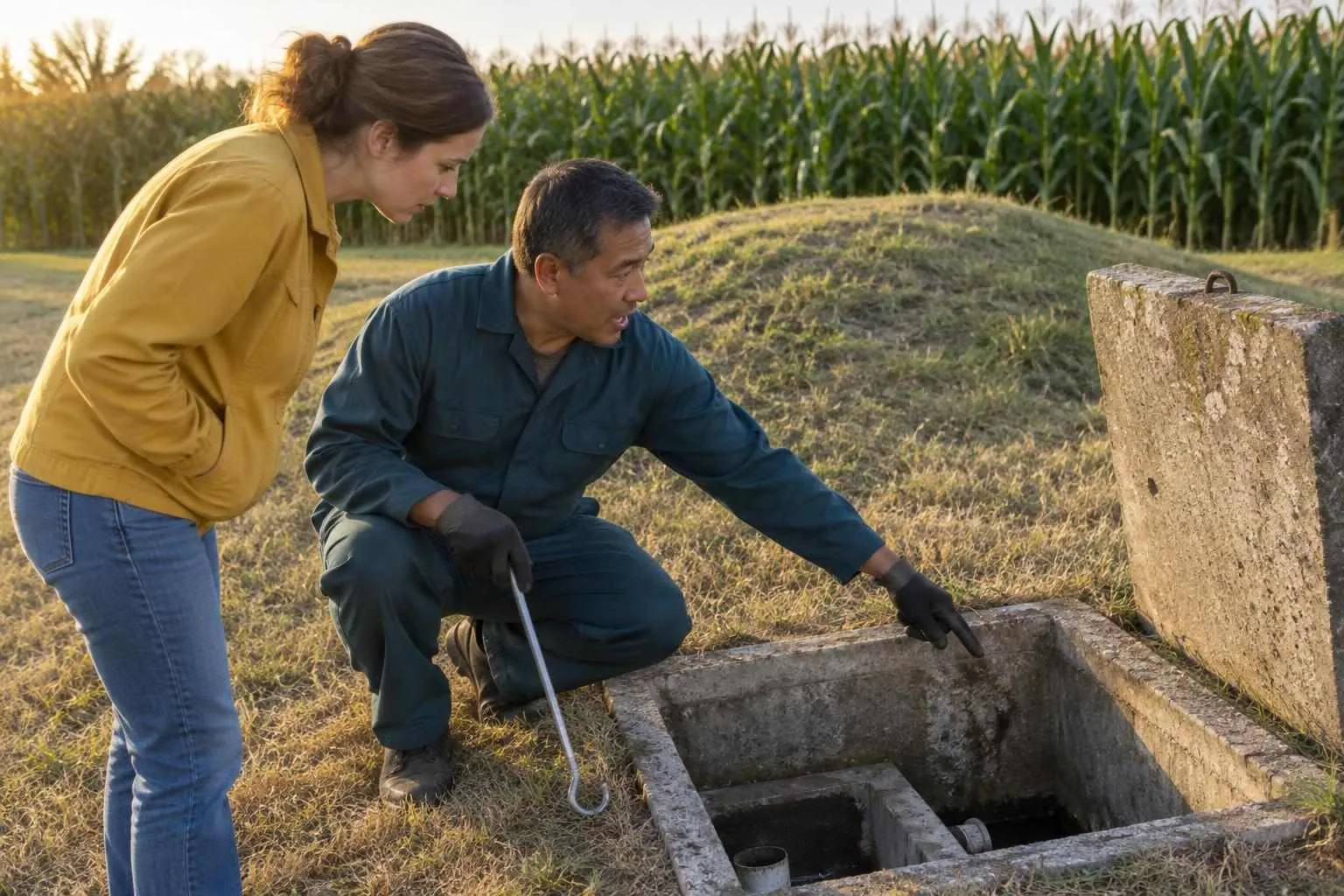
A certified inspection — whether that’s a PSMA-certified inspector in Pennsylvania, a Board of Engineers and Land Surveyors-licensed professional in Washington, or an InterNACHI-certified inspector anywhere else — follows a defined protocol. They’re required to check the drainfield for standing water, lush vegetation, and sewage odors. They run water and flush toilets to test distribution and absorption. They look for tree root intrusion, effluent screen clogs, cracked pipes, and lid integrity. They perform a flow test to catch blockages. They locate tank, leach lines, and pits, then inspect each for cracks and compromised tees.
A non-certified tank check looks at the tank. Leaks. Drainage. Holes. That’s largely it.
Those are not the same service. Calling them both “septic inspections” is like calling a tire pressure check and a full mechanical inspection both “car checkups.”
The Comparison Table
| Factor | Certified Inspector | Non-Certified Inspector |
|---|---|---|
| Scope | Full system: tank, drainfield, distribution box, pipes | Tank only: leaks, drainage, holes |
| Training requirement | Formal coursework + exam (PSMA, InterNACHI, state licensing) | None standardized |
| Required for home sales? | Often yes (varies by state/county) | Rarely accepted by lenders |
| Accepted by lenders/insurers | Yes | Sometimes no |
| Detects drainfield failure? | Yes | No |
| Regulatory compliance check? | Yes | No |
| Cost | Higher (reflects thoroughness) | Lower |
| Best for | Pre-sale, complex systems, required O&M, due diligence | Routine tank checks on known-good gravity systems |
When Certification Is Non-Negotiable
You’re buying a home. Penn State Extension is blunt about this: use a certified inspector before purchase, period. Lenders increasingly require it, and for good reason — the drainfield is where systems fail catastrophically and expensively, and a tank-only check won’t find it.
You’re in a regulated county. King County and Pierce County in Washington require property owners to submit proof of maintenance by certified professionals every one to three years. That’s not a suggestion — non-compliance means fines, legal exposure, and potential liability for groundwater contamination.
Your system is advanced. ATT systems, sand filters, mound systems, and aerobic treatment units require annual certified inspections in most jurisdictions. These aren’t gravity-fed systems a pumper can eyeball. They have mechanical components, electrical controls, and failure modes that require trained evaluation.
You’re adding living space. Increasing wastewater load on an existing system without a certified capacity assessment is how you end up with a failed drainfield two years after finishing your basement.
Reality Check:Most general home inspectors aren’t trained for septic systems. InterNACHI explicitly notes that septic inspection falls outside the standard home inspection scope and requires specialized training. If your home inspector is “including” the septic in a general inspection, ask specifically what they’re checking — and what they’re disclaiming.
When Experience Might Trump the Credential
I’ll be honest: there are scenarios where a non-certified inspector can be the right call.
If you’ve owned your home for ten years, had the system pumped regularly, have no symptoms (no slow drains, no odors, no wet spots), and just want confirmation the tank looks okay before a routine pump — an experienced local pumper who’s seen thousands of systems in your area has genuine value. They know the soil conditions, the common failure patterns, the specific equipment used in your neighborhood’s build era.
The credential doesn’t replace judgment. A PSMA-certified inspector who got certified last month may know the protocol cold but has less pattern-recognition than a pumper who’s been pulling tanks in your county for 25 years.
The credential does, however, give you recourse. It means someone passed an exam, carries insurance, and is accountable to a licensing body. When things go sideways — and in real estate transactions, they often do — “the certified inspector missed it” is a fundamentally different situation than “the Craigslist guy missed it.”
Pro Tip:Before hiring anyone, verify licensing and insurance. In Washington, professionals must be licensed by the Board of Engineers and Land Surveyors. In Pennsylvania, look for PSMA certification. Most state health departments publish online lookup tools for licensed onsite system professionals — use them. Takes two minutes and removes a lot of risk.
The Dye Test Myth
While we’re here: if someone is selling you a dye test as the primary diagnostic, that’s a yellow flag. InterNACHI specifically notes that dye tests are unreliable — the dye can be diluted by the volume of water in the system, or the delay between test and observation means you miss the result entirely. A proper certified inspection doesn’t rely on dye tests as the main event.
Practical Bottom Line
The credential matters most when the stakes are highest. Here’s a simple decision framework:
Hire a certified inspector if:
- You’re buying or selling a property
- Your county requires certified O&M inspections (check with your local health department)
- Your system is advanced (ATT, sand filter, mound, aerobic)
- You haven’t had a certified inspection in the last three years
- You’re planning construction or expansion that increases wastewater load
A non-certified pumper may be sufficient if:
- You’re doing a routine maintenance check on a simple gravity system
- You’ve already had a recent certified inspection and just want the tank pumped and eyeballed
- No sale, no lender, no regulatory requirement involved
Whatever you do, don’t skip the drainfield. It’s the most expensive part of the system to replace and the first thing a tank-only inspection misses. The entire point of a certified inspection is that someone trained to find drainfield failure is actually looking at your drainfield.
For a full overview of what to expect from the inspection process, see the Complete Guide to Septic System Inspectors. If you’re approaching a home sale, the related article on what septic inspection reports actually tell you walks through exactly how to interpret what you’ll receive.
The $75 Craigslist inspector is never actually a bargain.
Done reading? Get quotes from septic system inspectors near you.
Takes about a minute. Free, no obligation; providers reply to you directly.
Popular cities:
Nick built this directory to help homebuyers and homeowners find credentialed septic inspectors who provide unbiased evaluations — a conflict of interest he encountered firsthand when inspectors tied to pumping companies recommended costly repairs that an independent evaluator later deemed unnecessary.