Get free quotes from septic inspection near you
Takes about a minute. Free, no obligation; providers reply to you directly.
A friend who does septic inspections for a living once showed me a video from a colleague’s inspection — guy pulled up to a $600,000 property transaction with a brand-new crawler robot, fancy tablet app, the works. Spent 45 minutes fussing with the camera. Never actually checked the distribution box. Drain field failed six months after closing. The robot got great footage of a pipe that was fine. The part that mattered went unexamined.
That story lives rent-free in my head every time I see a septic equipment catalog.
The Short Version:A $200 camera and a $20 dye tablet in the hands of a thorough inspector beats a $15,000 crawler robot used by someone who doesn’t know what they’re looking for. The equipment that genuinely moves the needle is relatively modest — a decent inspection camera, a reliable probe, and good documentation software. Everything beyond that is useful under specific conditions, not universally necessary.
Key Takeaways
- The core toolkit for a quality septic inspection costs far less than vendors imply — technique and methodology matter more than hardware specs
- CCTV cameras and crawler robots are genuinely useful for pipe interiors, but only when paired with a systematic inspection protocol that includes components cameras can’t reach
- IoT monitoring sensors are the most transformative technology in the field right now — not for inspections, but for what they reveal between inspections
- Mobile documentation apps have real value; paper forms transcribed later are a liability
The Gear Industry’s Favorite Trick
The septic equipment market is growing fast. The global wheel in-pipe inspection robot segment alone was valued at $1.05 billion in 2025 and is projected to hit $2.15 billion by 2034 — a 7.8% CAGR. That’s a lot of companies with a financial interest in convincing you that better robots equal better inspections.
They’re not wrong that the technology is improving. They’re just quietly omitting that the technology was never the limiting factor for most residential inspections.
Here’s what most people miss: a residential septic inspection is fundamentally a systems evaluation. You’re checking the tank condition, baffle integrity, the distribution box, the drain field, and the effluent quality — and most of those components aren’t inside a pipe. A crawler robot that gives you stunning HD footage of your inlet baffle does nothing for a soggy drain field or a cracked distribution box lid that’s letting groundwater in.
What Actually Matters
Inspection Camera (the real workhorse)
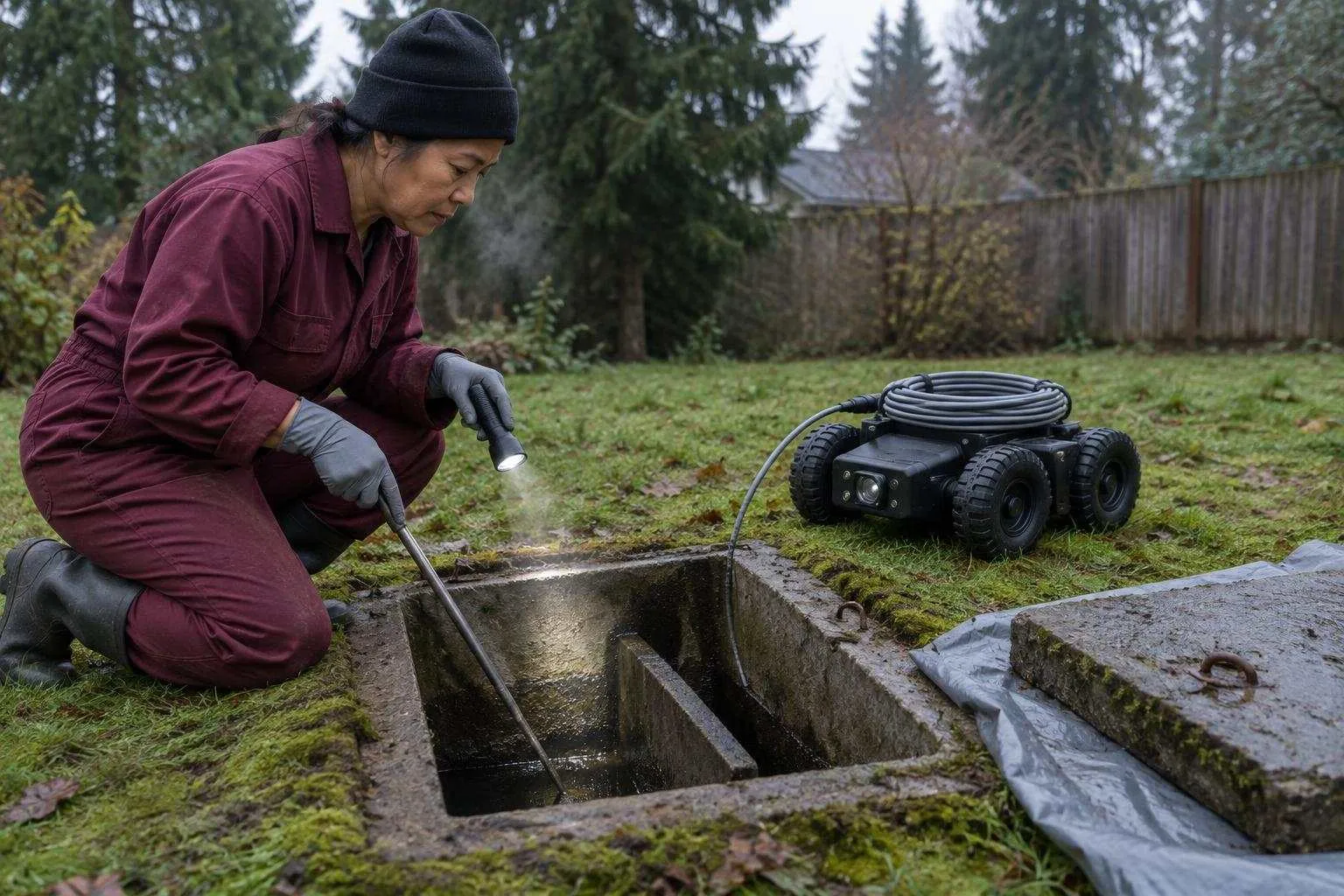
A push-rod fiber-optic camera — typically 1–1.5 inches in diameter, 100+ feet of cable — is the single most useful piece of specialized equipment in the kit. You’re looking for cracks in the tank walls, baffle condition, root intrusion in outlet pipes, and blockages. You don’t need pan-tilt capability for most residential work. A basic color camera with decent resolution handles the job.
Where HD pan-tilt cameras on crawler robots earn their price: large-diameter commercial pipes, complex municipal-adjacent systems, or when you’re trying to document deformation or calculate ovality. For a standard 1,000-gallon residential tank serving a family of four — typically pumped every 3–4 years — you’re not deploying a crawler.
Probe and Sludge Judge
Unglamorous. Indispensable. A sludge judge — basically a clear acrylic tube with a check valve — tells you exactly how much sludge and scum you’re dealing with before pumping. A steel probe lets you feel for drain field saturation and locate tank lids without digging blind. Combined cost: under $150. Impact on inspection quality: significant.
Reality Check:Inspectors who skip the sludge judge are guessing at pump schedules. Inspectors who skip probing the drain field are hoping it’s fine. Neither is an inspection — it’s a visual drive-by.
Dye Testing Kit
Fluorescent dye tablets flushed through the system reveal surface breakout, improper connections, and drain field saturation. Cost: $20–$40 for a supply that lasts months. The limitation is obvious (dye won’t reveal a marginal field that passes on inspection day but fails in wet season), but it’s a fast, cheap screen that catches clear failures.
Mobile Documentation App
This one actually is worth paying for. NAWT-standard report formats are increasingly required by lenders, and multiple states now mandate electronic submission to state databases. An inspector completing documentation on a tablet on-site — with photos auto-embedded and the report auto-generated before leaving the property — produces a more accurate, defensible record than paper forms transcribed hours later.
Pro Tip:If your documentation workflow involves handwriting anything and then typing it up later, you’re introducing transcription errors into a legal document. That’s a problem when a buyer’s attorney is reviewing it at closing.
The Comparison Table: Essential vs. Optional vs. Marketing
| Equipment | Cost Range | Genuine Value | Who Actually Needs It |
|---|---|---|---|
| Push-rod inspection camera | $300–$2,500 | High — pipe and tank interior visibility | Every inspector |
| Sludge judge / probe set | $50–$150 | High — quantifies sludge layer, locates components | Every inspector |
| Dye test kit | $20–$40 | Medium — catches surface breakout | Every inspector |
| Mobile inspection app | $50–$200/mo | High — NAWT-compliant, lender-ready reports | Every inspector |
| HD crawler robot (pan-tilt) | $8,000–$25,000+ | Medium — excellent for complex/commercial pipe work | Commercial/municipal specialists |
| Laser profiling attachment | $15,000–$40,000 | Low for residential — useful for structural deformity mapping | Large-scale municipal contractors |
| 3D point cloud mapping system | $20,000+ | Marketing for most residential use cases | Niche engineering applications |
| IoT sensor monitoring system | $200–$800/install | High — but for ongoing monitoring, not inspection | Inspectors offering monitoring contracts |
The IoT Exception
I’ll be honest — the one technology category that genuinely changes the picture isn’t inspection equipment at all. It’s monitoring equipment.
Flow sensors, pressure alarms, and remote level monitoring installed in tanks give you real data between inspection visits. They catch high-water events before they become drain field failures. They enable what the industry calls performance-based management — evaluating systems on actual treatment effectiveness rather than a visual snapshot every few years.
For an inspector building a service offering beyond one-time transaction inspections, IoT sensors represent real differentiation. They also produce the kind of continuous data that makes AI-driven service interval recommendations actually meaningful — instead of the generic “pump every 3–4 years” rule-of-thumb that ignores household size, usage patterns, and tank condition history.
Reality Check:AI interval optimization is a real thing, but it requires data. An inspector who installs a sensor and revisits with trend data has something to offer. An inspector who quotes “AI-optimized scheduling” based on a single inspection visit is selling vibes.
The Technique Problem Nobody Talks About
The septic inspection market is going through a technology upgrade cycle. That’s mostly good. But there’s a version of this story where inspectors spend $15,000 on crawler robots and $500/month on sensor dashboards while still not checking the effluent filter, still missing the signs of drain field channeling, still writing “appeared functional at time of inspection” as a liability hedge instead of a finding.
Equipment is a multiplier. It multiplies good technique, and it multiplies bad technique. A thorough inspector with a $300 push-rod camera will catch more failures than a sloppy one with $30,000 in robotics.
This matters for buyers commissioning inspections too. The questions to ask aren’t about what gear the inspector uses — they’re about what the inspection protocol actually covers. Does it include drain field probing? Distribution box inspection? Effluent filter check? Those don’t require fancy equipment. They require showing up with a plan.
Practical Bottom Line
If you’re setting up as a residential septic inspector:
- Start with the essentials — push-rod camera, sludge judge, probe, dye kit, mobile app. Total investment under $3,000 for a solid baseline kit.
- Add crawler/HD capability if and when you’re doing commercial work or complex systems that genuinely need it — not because a catalog told you it’s the professional standard.
- Consider IoT monitoring as a service expansion, not an inspection upgrade. It’s a different business model, but a compelling one.
- Invest in NAWT certification and protocol discipline before investing in more equipment. The report format matters to lenders. Your checklist discipline matters to your clients.
For the full picture of what a professional septic inspection actually covers — from credentials to what’s included in a compliant report — see The Complete Guide to Septic System Inspectors.
The robot gets great footage. The inspector finds the problem.
Done reading? Get quotes from septic system inspectors near you.
Takes about a minute. Free, no obligation; providers reply to you directly.
Popular cities:
Nick built this directory to help homebuyers and homeowners find credentialed septic inspectors who provide unbiased evaluations — a conflict of interest he encountered firsthand when inspectors tied to pumping companies recommended costly repairs that an independent evaluator later deemed unnecessary.