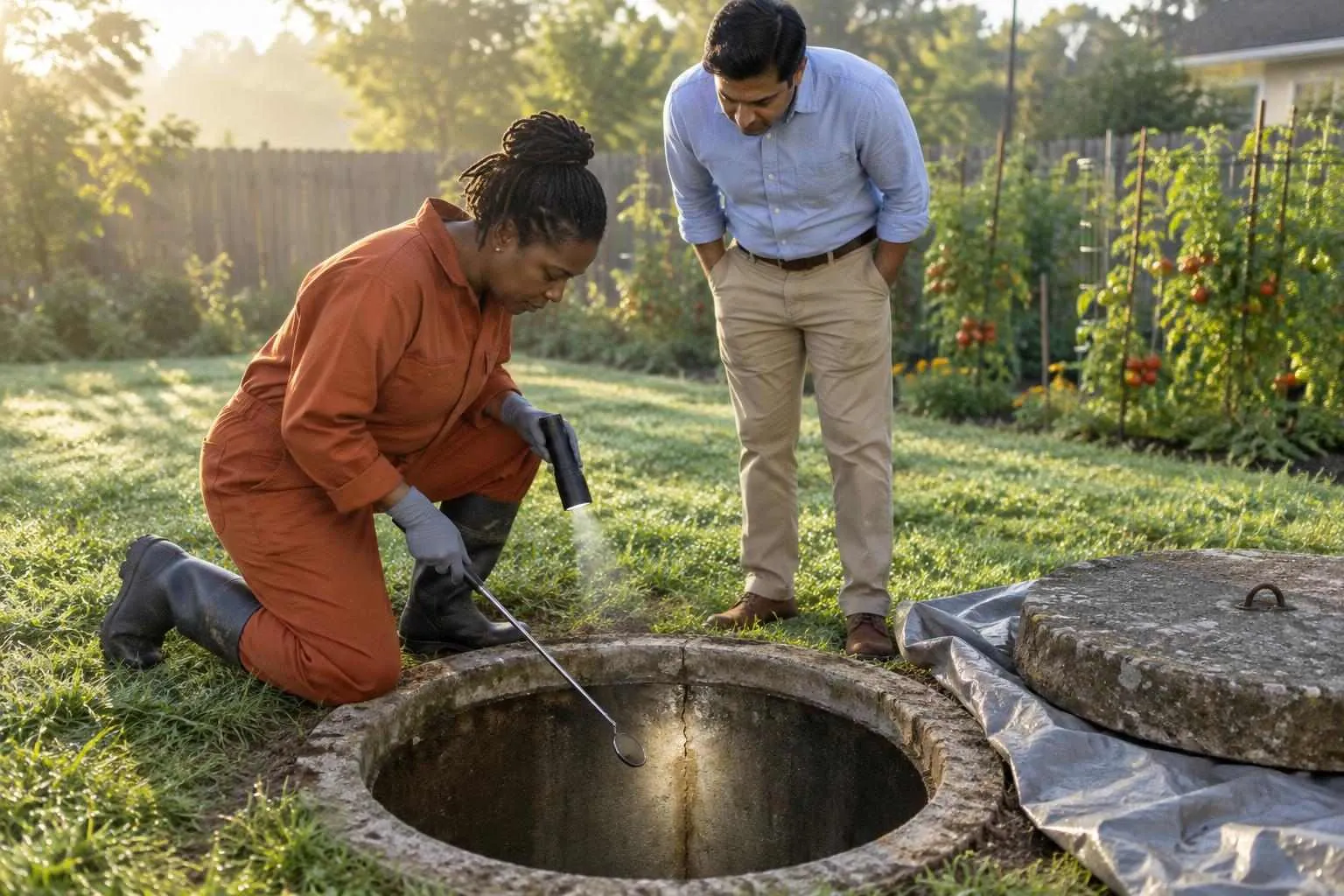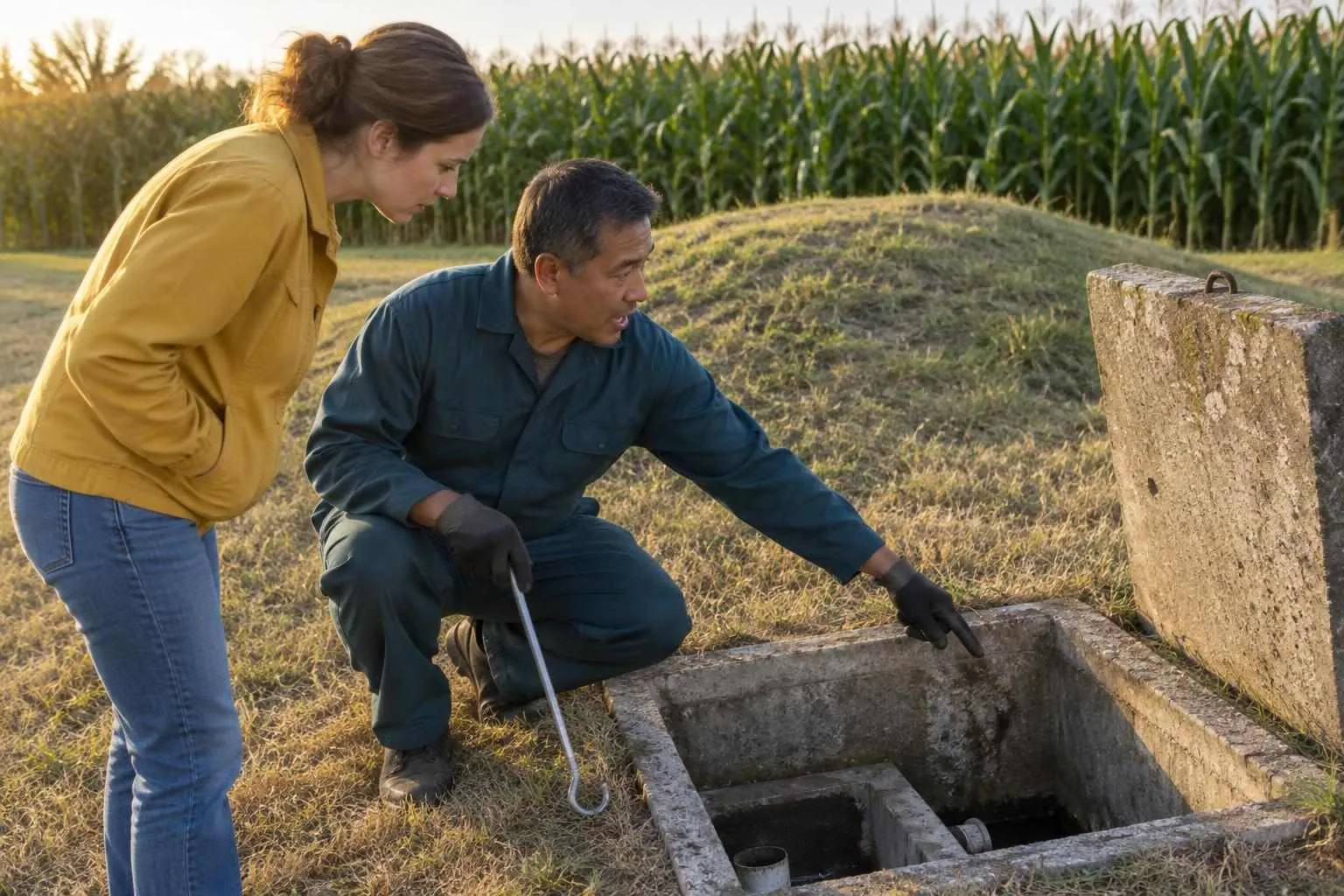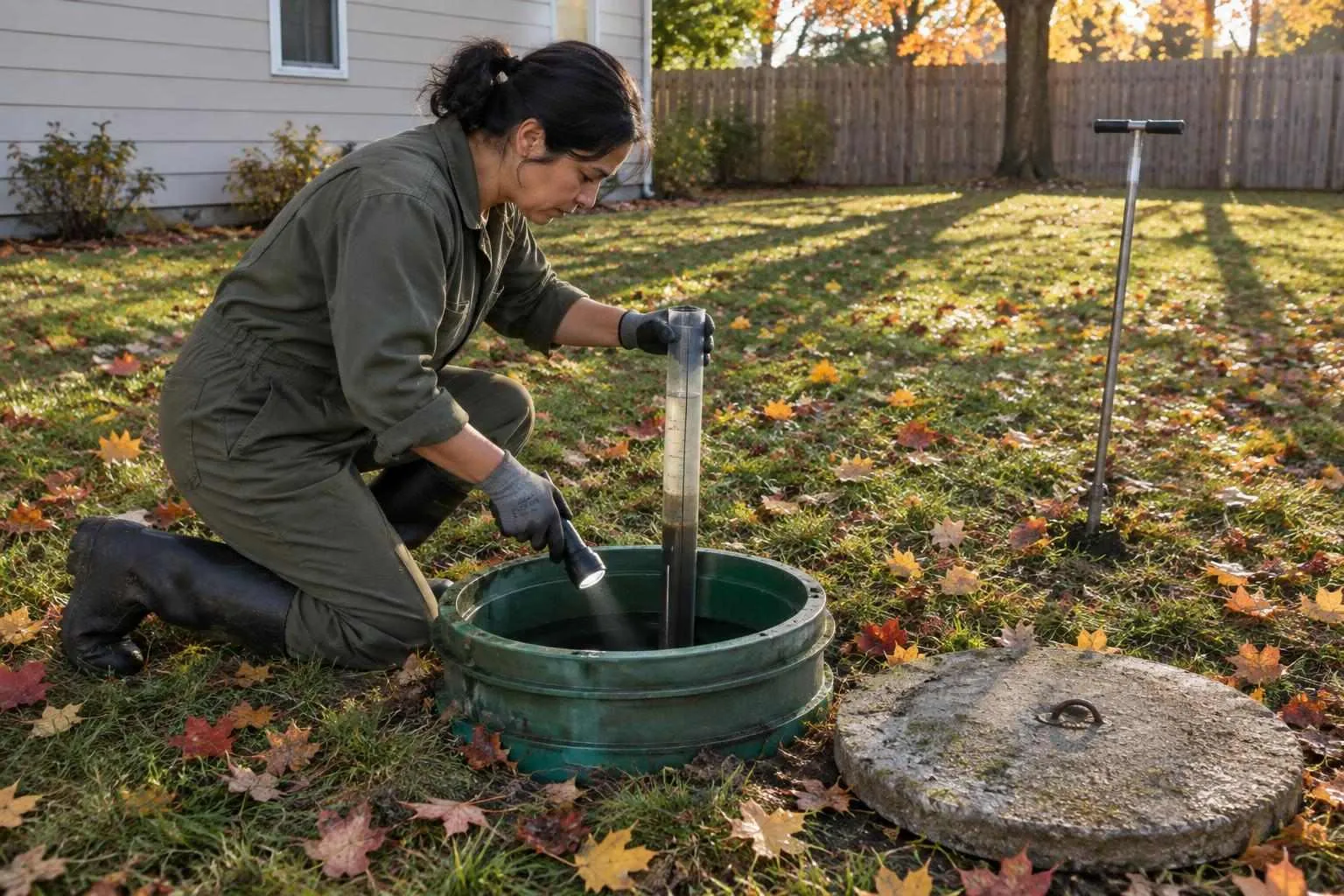
Are you a septic system inspector?
SepticTrust lists 346 septic system inspectors. A free listing gives you a profile page and quote requests from people looking for septic inspection near you, sent straight to your inbox.
A few months back, a septic inspector friend texted me a screenshot. It was an AI-generated LinkedIn post claiming that “autonomous drone systems will fully replace septic inspectors within five years.” He added one word: “lol.”
He’s been doing this work for eleven years. He’s crawled under decks in January to locate tank lids. He’s read drainfield conditions that looked fine on paper but smelled like failure. He knows what a compromised baffle looks and sounds like. And he’s been watching the AI hype cycle churn out takes like this one for the past two years.
I wanted to give him — and you — a straight answer. So I actually looked into it.
The Short Version:AI is genuinely transforming the back-office and data side of septic work — processing reports, predicting maintenance cycles, automating outreach. It is not replacing the licensed inspector crawling under your deck and signing their name to a compliance report. Not in five years. Probably not in twenty.
Key Takeaways
- AI tools trained on hundreds of millions of feet of sewer/culvert inspection data can auto-classify defects and generate reports in minutes — for underground municipal pipe systems.
- For onsite residential septic systems, the AI value today is in document processing, predictive scheduling, and CRM automation — not field inspection.
- Manual report processing currently caps at 5–6 reports per day per assistant. AI-assisted OCR/RAG pipelines remove that ceiling entirely.
- The professional consensus: AI augments field crews. It handles the paperwork. Humans handle liability, regulatory sign-off, and anything that requires putting eyes (and a flashlight) on a tank.
What AI Is Actually Good At (In This Industry)
Here’s where AI is earning its keep right now — and it’s not where you think.
The real action is in the data layer. Septic service companies accumulate years of handwritten inspection reports, scanned PDFs, and unstructured service histories. That information sits in a filing cabinet doing nothing. Companies like Phazur Labs built a system called RoadRunner that uses OCR and retrieval-augmented generation (RAG) to pull all of that dormant data into a structured format — then uses it to predict which customers are due for pumping or inspection, and automatically fires off personalized SMS and email outreach.
Nobody tells you this part: the bottleneck that AI solves first is never the sexy field work. It’s the five-to-six reports per day that a single office assistant can manually process before burning out. Remove that ceiling, and a small operation can scale its follow-up pipeline dramatically without adding headcount.
On the municipal sewer side — which is adjacent but distinct from residential septic — the technology is further along. SewerAI has trained models on hundreds of millions of feet of inspection footage. VAPAR integrates with Autodesk Info360 to let utilities upload CCTV videos and receive severity-prioritized repair plans in minutes. Robotic systems like the Clearpath Jackal UGV navigate pipes autonomously with LIDAR, cameras, and GPS, detecting defects at 20 frames per second in real time.
Impressive. Also: completely inapplicable to a 1,000-gallon concrete tank buried four feet below a New Hampshire backyard.
The Comparison You Actually Need
| Task | AI Capability Today | Still Requires a Human |
|---|---|---|
| Defect detection in municipal sewer pipe (CCTV) | High — automated at 20 FPS, trained on millions of feet | Human QA review recommended |
| Report transcription and processing | High — OCR + RAG handles handwritten/scanned PDFs | Initial data capture at field |
| Predictive maintenance scheduling | High — sensor data + ML flags anomalies | Customer decision-making |
| Automated follow-up outreach | High — CRM integration, voice callbacks, SMS | Relationship management |
| Physical tank inspection + pumping | None | Licensed inspector |
| Drainfield condition assessment | None | Licensed inspector |
| Regulatory compliance sign-off | None | State-licensed professional |
| Real estate transaction inspection report | None | Credentialed inspector (NAWT CI, state license) |
The pattern is obvious once you see it: AI handles data that’s already been captured. It doesn’t capture new data from systems that require someone to physically show up.
Why “AI Will Replace Inspectors” Is the Wrong Frame
Reality Check:The inspection itself isn’t the bottleneck. It’s everything around it — the scheduling, the report writing, the follow-up. That’s where AI is winning. And winning there doesn’t eliminate the need for the inspector; it makes a single inspector more productive.
Septic system inspection is high-stakes work. A missed failure during a real estate transaction can cost a buyer tens of thousands of dollars and expose the inspector to liability. The report an inspector signs is a legal document. That’s not a process you automate — that’s a process where human judgment and professional accountability are the entire product.
Even in the more mature municipal sewer AI space, the consensus from practitioners isn’t “we’re replacing people.” It’s “our crews used to spend 80% of their time on paperwork. Now they spend 80% of their time on actual repairs.” Eric Sullivan at SewerAI has talked about this directly: AI cuts cost and human error in the analysis phase, enabling continuous monitoring and data-driven repair decisions. The crew still does the repairs.
That’s the pattern across every real deployment. AI handles triage. Humans handle execution and accountability.
What This Means If You’re a Septic Inspector
The practical implication isn’t fear — it’s opportunity.
Pro Tip:If you’re running a septic service business and you’re still manually entering report data or chasing down past customers by hand, you’re leaving money on the table. The AI tools exist. The question is whether you’ll use them before your competitor does.
The inspectors who’ll feel pressure aren’t the ones doing good field work. They’re the ones whose entire value proposition is filling out the paperwork — and even that’s a slow-moving threat, not an overnight disruption.
What’s actually happening is a bifurcation. The administrative and marketing functions of septic service companies are getting cheaper and more scalable via AI. The technical, credentialed, liability-bearing work at the field level is not. If you’re a licensed inspector in your area, your certification and your judgment are more valuable relative to data entry than they were five years ago — not less.
Practical Bottom Line
AI is coming for septic report processing, maintenance prediction, and customer outreach. It is not coming for the person who shows up with a probe rod and signs their name to a compliance document.
Here’s what to actually do with this:
- If you run a septic service business: Look at tools in the AI-assisted CRM/scheduling space. The ROI on automating follow-up outreach from dormant inspection data is real. RoadRunner-style systems are not science fiction.
- If you’re a working inspector: Your license and your field judgment are the moat. Keep your certifications current. The NAWT CI and state licensing requirements aren’t going away — regulators aren’t delegating sign-off to an algorithm.
- If you’re hiring an inspector: AI tools don’t change what you should look for. You want a licensed, credentialed professional with local drainfield knowledge. Read the full breakdown in our Complete Guide to Septic System Inspectors.
I’ll be honest: the five-year “full replacement” takes are written by people who’ve never watched someone probe a saturated drainfield on a cold morning, then explain to a first-time homebuyer why the house they love has a $25,000 problem in the backyard.
That conversation isn’t getting automated. The person having it just might have a better CRM.
Done reading? Get quotes from septic system inspectors near you.
Takes about a minute. Free, no obligation; providers reply to you directly.
Popular cities:
Nick built this directory to help homebuyers and homeowners find credentialed septic inspectors who provide unbiased evaluations — a conflict of interest he encountered firsthand when inspectors tied to pumping companies recommended costly repairs that an independent evaluator later deemed unnecessary.